
Where Goleta City Directories Survive
Goleta directories are best treated as verified points on a scattered research shelf, not as one annual series. The earliest confirmed item is the 1904 Dana Burks volume. Later Polk editions are known for selected years only. The same name trail can also move through the Santa Barbara County Genealogical Society database, Sahyun Library holdings, UCSB archival collections, and Santa Barbara Public Library newspapers. The coverage table keeps those sources distinct so a gap is not mistaken for a missing person.
| Collection | Years | Publisher or keeper | Where held | Access |
|---|---|---|---|---|
| Dana Burks Santa Barbara directory | 1904 | Santa Barbara Directory Company | FamilySearch Digital Library, item 2171498 | Marked online; viewer conditions apply |
| Selected Polk editions | 1954, 1967, 1968, 1969, 1974, 1983, 1984-85 | Polk | SBCGS and cited local collections | Edition-by-edition; not continuous |
| SBCGS local-name database | Record-specific | Santa Barbara County Genealogical Society | Sahyun Library and online index | Free index; image or service may cost |
| Santa Barbara History Collections | Collection-specific | UCSB Special Research Collections | Finding aids and archival boxes | Request materials in advance |
| Local newspapers and obituary files | Runs vary | SBPL, SBCGS, Historical Museum | Microfilm, albums, and archives | In person or paid research request |
The table does not support a complete local run. No authoritative reverse-directory year list, final printed year, or continuous 1904-to-1985 sequence was verified. Cite each edition, index hit, or archival box separately.
Note: A verified edition year is safer than a guessed continuous run when local catalog records leave gaps.
Goleta's 1904 City Directory Quirk
The 1904 Dana Burks directory is unusually useful because Goleta appears in the title alongside Santa Barbara, Carpinteria, Montecito, and Summerland. The full title describes private citizens and businesses in all five communities. At 381 pages, it is a regional volume, not a narrow municipal list. FamilySearch Digital Library item 2171498 is marked online, although the viewer’s access and page-reading conditions still control what can be checked.
That broad scope changes the first search question. A name found under Goleta may point to the wider valley rather than the incorporated city line used today. Compare the listed place, street, nearby business, and later records with modern Goleta geography. The regional format is an insider clue: a useful result can be real and still sit outside present-day city limits. It also explains why Santa Barbara County, California, remains the right historical frame for many Goleta searches.
Selected Goleta Directory Years
Polk material supplies later checkpoints, but the safe chronology is deliberately short. Verified individual editions include 1954, 1967, 1968, 1969, 1974, 1983, and 1984-85. The 1954 citation is described as Polk's Santa Barbara including Montecito. Those dates can test whether a surname, business, or street clue reappears, yet they do not fill the years between them.
Do not turn selected Polk editions into a complete run. Missing volumes may reflect a collection gap, a different title, or a person who was not listed. No authoritative reverse-directory years or last printed edition were located. Treat each appearance as a dated observation and keep absent years open. Pair a gap with census, obituary, deed, probate, or institutional evidence.
Reading a Goleta City Directory Entry
A Goleta city directory entry should be read as a dated lead, not as a modern identity record. The 1904 viewer did not yield a verified legible Goleta sample entry or an abbreviation-key page. The inventory is therefore a field checklist for a readable scan, informed by the Library of Congress city-directory guide, not a claim that every field appears in the Dana Burks volume.
| Printed name | Copy the spelling, initials, and any name order exactly from the scan. |
|---|---|
| Occupation or employer | Use the line only when printed; the classified or business section may help decode it. |
| Residence or address | Record the street clue and place label; a street or householder section may not exist in every edition. |
| Spouse or widow note | Check for a spouse, widow, or similar relationship note before drawing a family link. |
| Owner or renter mark | Look for an edition key before interpreting any owner or renter symbol. |
- Criss-cross section
- A street-order section that can move from a known address toward a listed name, but only when that edition contains one.
- Householder index
- A name or household index that points to a listed household, not proof that every occupant appears.
- Abbreviation key
- The publisher's explanation of short marks and terms. No Goleta-specific key was verified, so symbols should remain unexpanded until the volume confirms them.
The Library of Congress directory reference gives useful context for common city-directory parts and access routes.
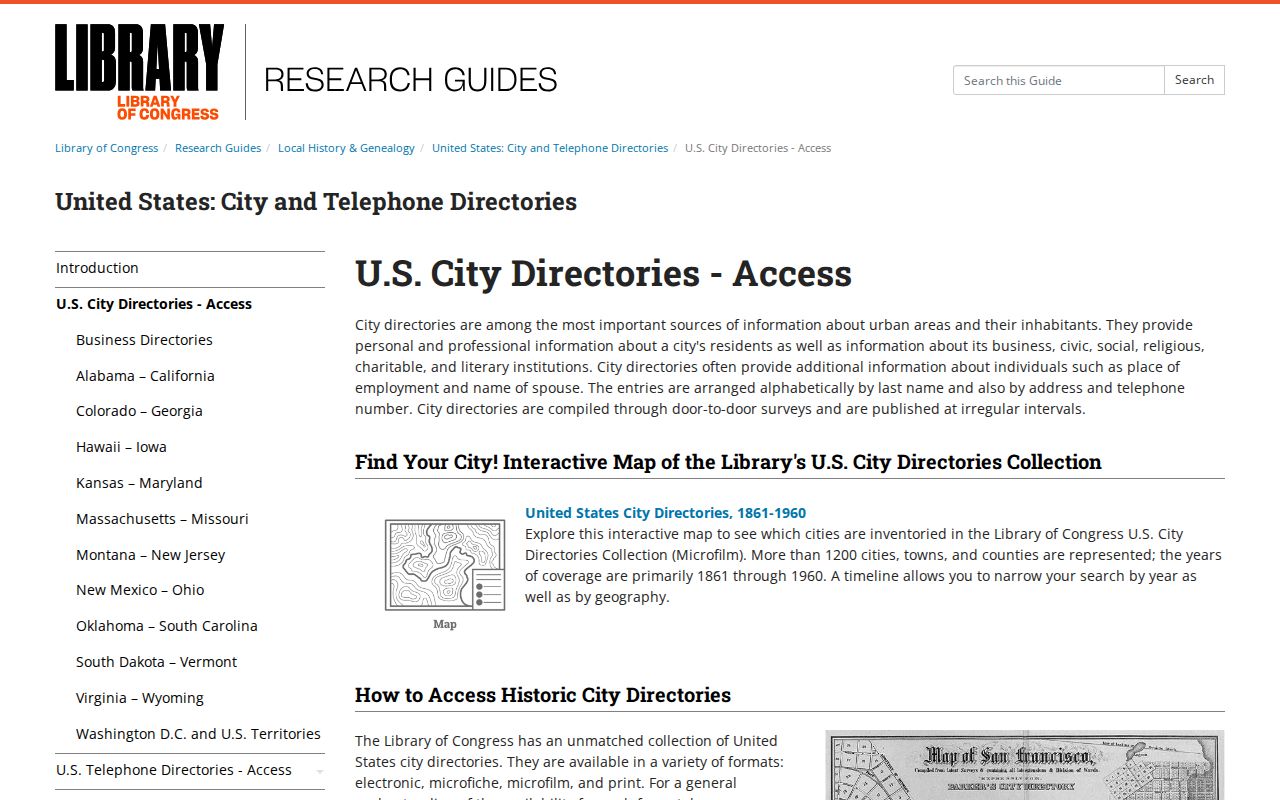
That national reference helps distinguish a general directory convention from a feature that has actually been verified in a Goleta volume.
Sahyun's Goleta Directory Index
The Santa Barbara County Genealogical Society search database is a strong companion to printed directories. It held more than 200,000 local names after its September 2, 2025 update. The search is case-insensitive. A blank search can return all records, an asterisk works as a wildcard, dates can use a year or a plus-or-minus range, location comes from a dropdown, and keywords can surface aliases, juror or witness roles, military facts, and credentials.
Categories reach beyond ordinary household lists. Obituary, probate, burial permit, coroner inquest, livestock brand, squirrel lien, naturalization, mortuary, and city death-return categories can explain why a person appears in one index but not a complete directory list. The index is a citation, not the underlying image. A service or image may require a separate request, so note the category, date, place, role, and ordering information before treating a hit as a fact.
The Santa Barbara County Genealogical Society search database shows the local name-index route used alongside directory research.
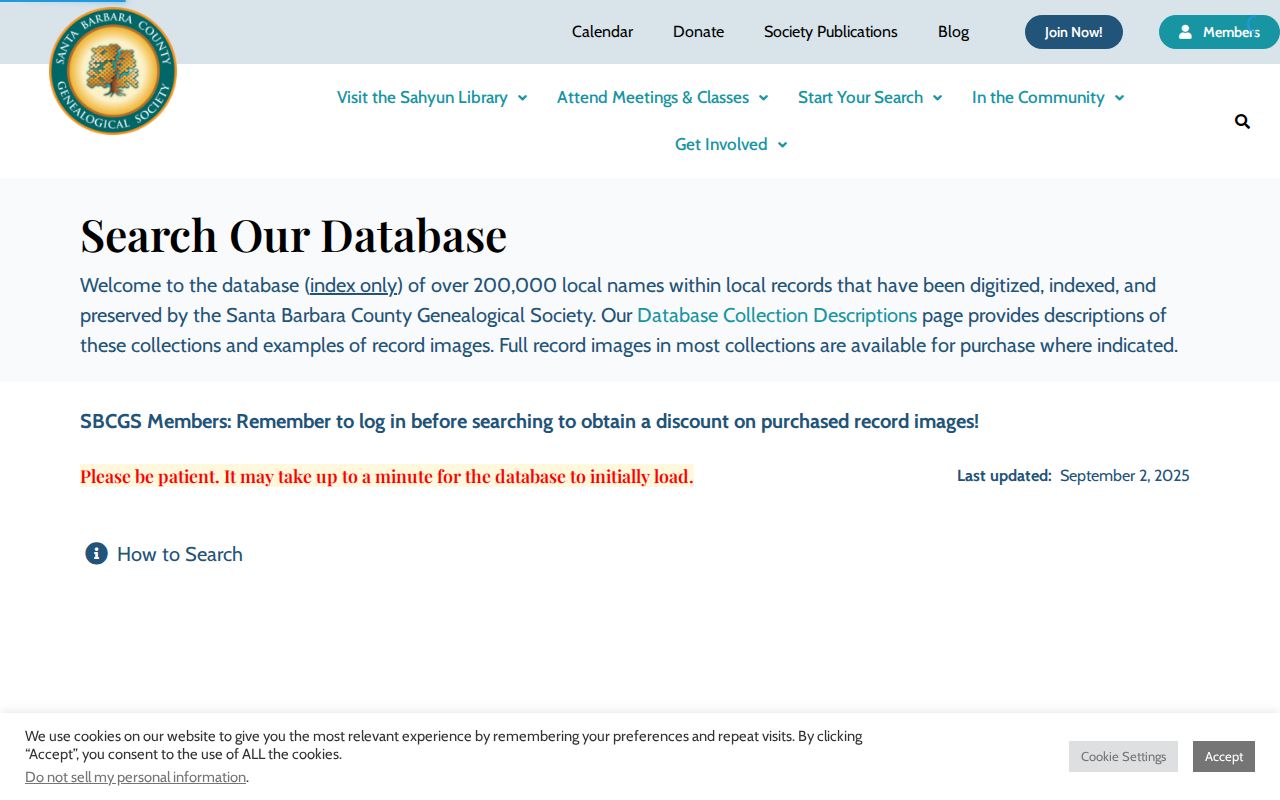
Its filters make a narrow surname search more useful, while the blank-search behavior is a reminder to add one constraint at a time.
Sahyun Library at 316 Castillo Street in Santa Barbara has more than 22,000 items, over 750 periodical titles, and 7,845 searchable periodical files, plus directories, yearbooks, maps, and surname or locality files. The reference desk is 805-884-9909. Hours are Tuesday and Thursday 10-4, most Sundays 1-4, and the third Saturday 1-4 from September through July. As a FamilySearch Affiliate, Sahyun offers onsite resources that can open restricted images.
UCSB Goleta History Collections
UCSB Special Research Collections add context that a printed directory rarely supplies. The finding aids include the Goleta Chamber collection from about 1943-1994, Justin Ruhge material from about the 1970s-2007, Community Development and Conservation records from about 1892-1995, Goleta Water District packets, airport and Goleta Slough material, South Coast Railroad Museum records from about 1878-1976, Walker Tompkins papers from 1849-1989, and Santa Barbara Public Library archives.
These collections add civic, business, land, water, transportation, or community context to a directory name. They are not a universal resident directory. Identify the collection and date span, then request boxes or folders in advance.
The UCSB Santa Barbara History Collections finding aids identify the Goleta-related archival groups that extend beyond printed directories.
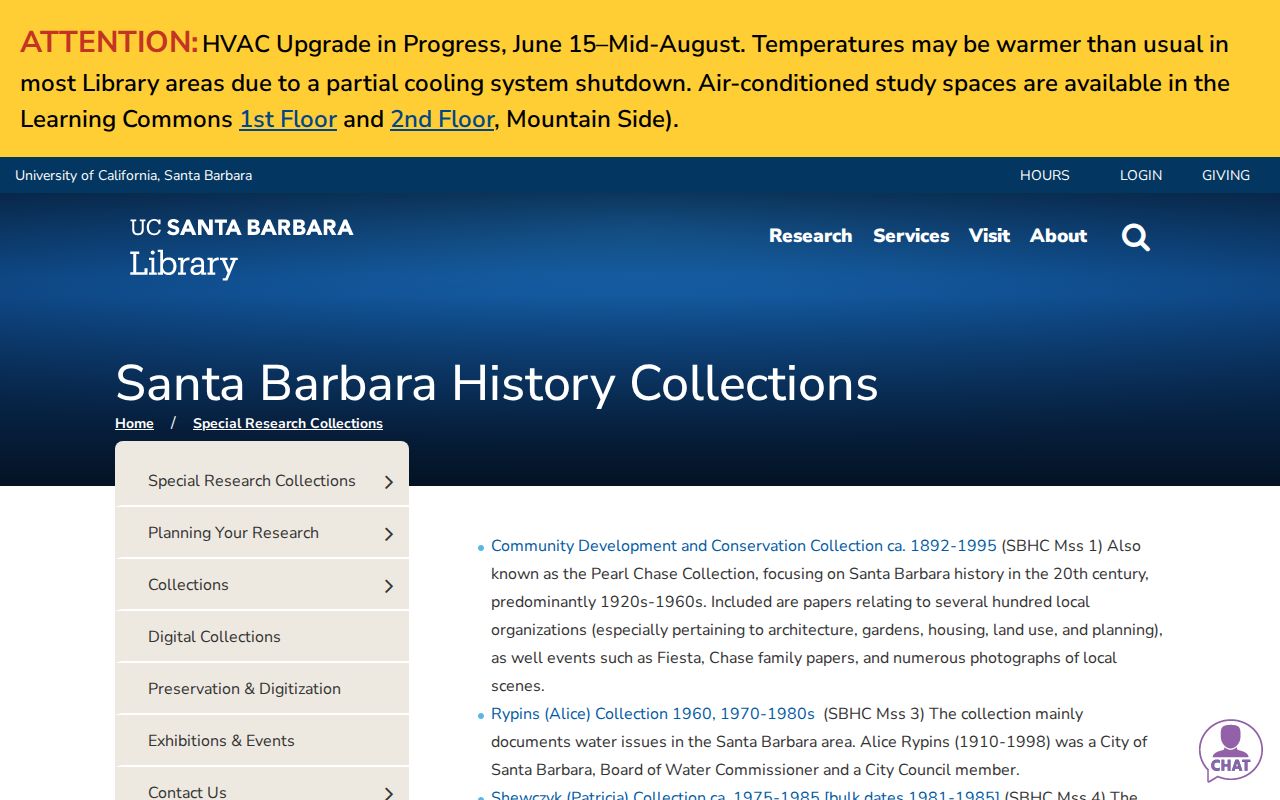
The dates add context without turning the archive into a name index.
Rancho La Patera and Stow House, operated by the Goleta Valley Historical Society, offer another local-history route. No public online name index or archive catalog was found. Museum hours and tours are seasonal, so verify access before relying on a visit for a directory lead.
The genealogical society holdings reference also points toward directories and school material that can supplement a Goleta household trail.
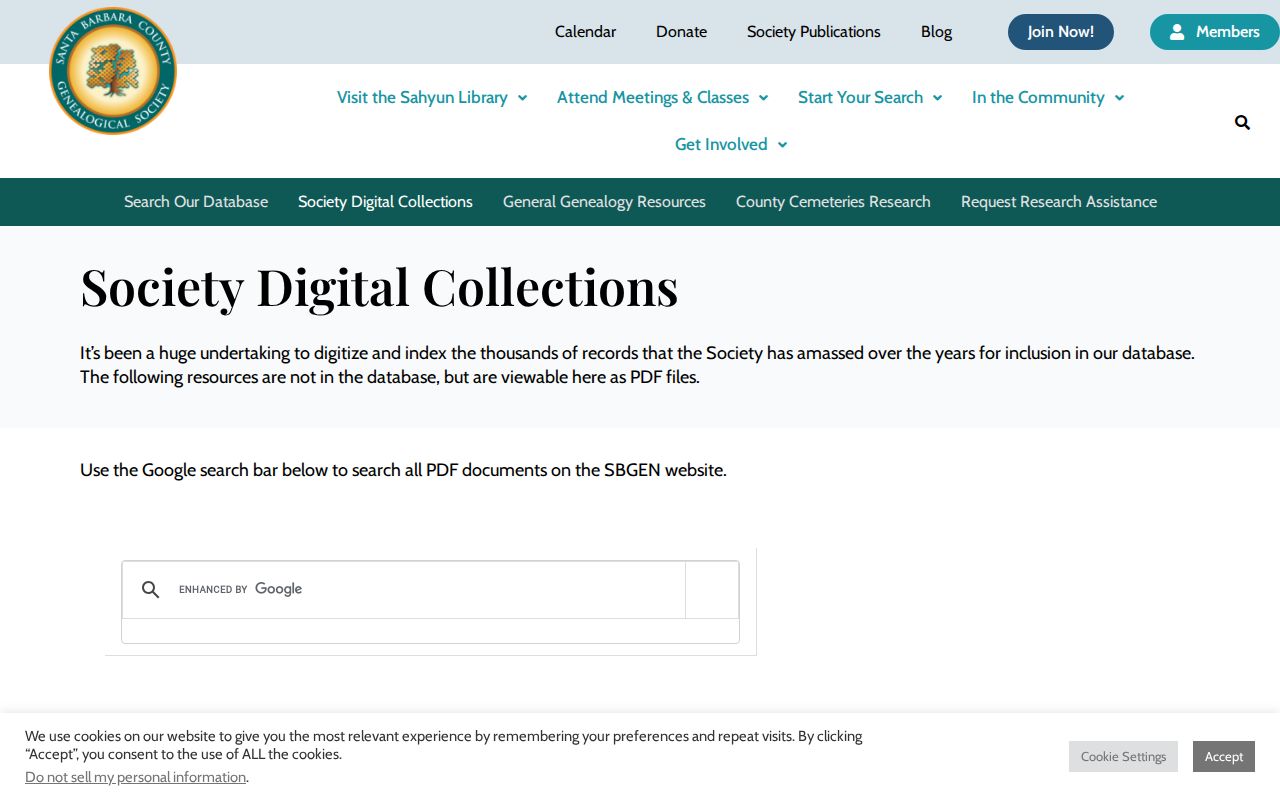
School material can identify a classmate or affiliation, but not a current address.
Trace Goleta Families across Directories
Using Goleta city directories for family history works best as a series of small checks. Start with the surname, then widen the search to spelling variants and initials. Read occupation, employer, residence, and any relationship notation as clues that need a second record. A classified or business section can decode an employer reference. A street or householder section is useful only if that edition actually contains one.
- Find the earliest plausible appearance and copy the name, place label, occupation, and address exactly.
- Search spelling variants, initials, and nearby place names before deciding that a person is absent.
- Compare consecutive available editions for a move, a spouse or widow note, an arrival, or a disappearance.
- Use the classified or business section to clarify an employer, trade, or company reference when printed.
- Pair the 1904 directory with the 1900 and 1910 census, then use later census schedules and dated newspapers where available.
- Close a possible death or inheritance trail with the SBCGS obituary or probate categories, not with an unverified directory gap.
A name that drops out may reflect a move, death, a missed edition, a different spelling, or a person who was not listed. The next record should decide which explanation fits. If a directory clue needs a present-day check, an internal Goleta resident lookup can shift the question to court, vital, business, or other official records without rebuilding the historical shelf.
Census Clues for Goleta Directory Research
The National Archives census guidance is the right companion for the 1904 Dana Burks item. Pairing the directory with the 1900 and 1910 census can test household members, place labels, tenure, and age ranges across the decade gap. Federal census schedules are public through 1950 under the 72-year release rule. A later Polk checkpoint can then be compared with newspapers, probate, or a school and institutional record rather than treated as a census substitute.
The place-name problem is local and persistent. Early settlement names include La Patera around Fairview and Hollister and La Goleta around Patterson and Hollister. Search Goleta, La Goleta, La Patera, Santa Barbara County, and the broader valley label when a 1900 or 1910 schedule does not match a modern city term.
The National Archives census research guide provides the public-release context for pairing federal schedules with local directories.
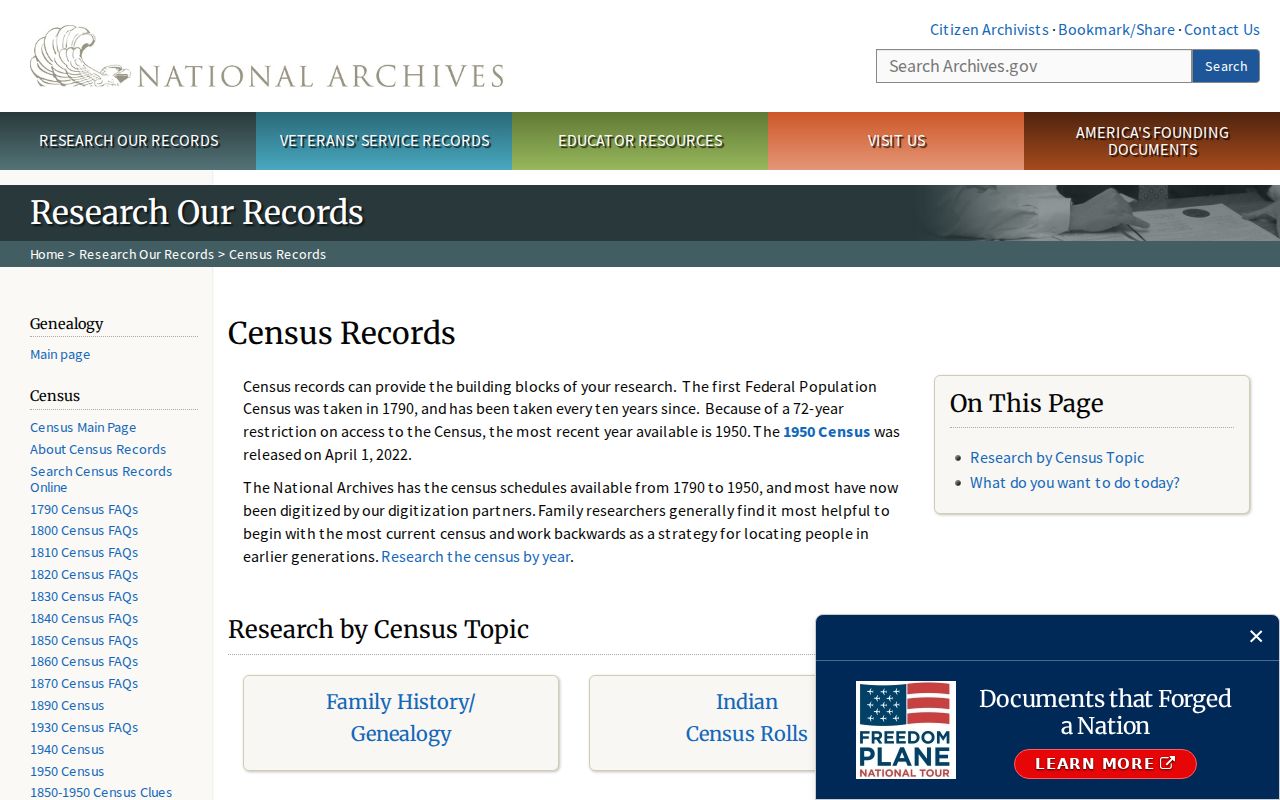
A census schedule can test a household at one date, while a directory supplies a nearer year or an occupation and street clue. Neither source should be stretched into a complete resident list.
Goleta City Directory Library Access
Goleta Valley Library serves beyond incorporated Goleta. Its permanent 500 North Fairview building closed in April 2025 for renovation. GVL Express is at 6500 Hollister Avenue, Suite 105, Goleta, California 93117, phone 805-964-7878. FY 2025-26 research is $26 per 30 minutes; interlibrary loan is at least $15. A catalog result can be useful without proving city residence.
The Goleta Valley Library online research page routes genealogy, history, directory, and newspaper questions. Separate temporary service from Sahyun, SBPL, UCSB, and Rancho La Patera holdings, and verify reopening or seasonal access before visiting.
Local Obituaries after Goleta City Directories
Santa Barbara Public Library Central offers free in-person newspaper microfilm and local-history use. Its mail obituary service costs $25 per person for a ten-day date window. Other local-history research is $50 per 30 minutes, payable even with no result, with an estimated two-to-four-week response. A request should include a death name and date, or useful names, events, and dates, plus requester contact details. Mail goes to Reference Unit, Obituary/Local History Request, PO Box 1019, Santa Barbara, California 93102.
The Santa Barbara Public Library local-history research page explains the microfilm and paid mail routes that remain available when a printed volume leaves a gap.
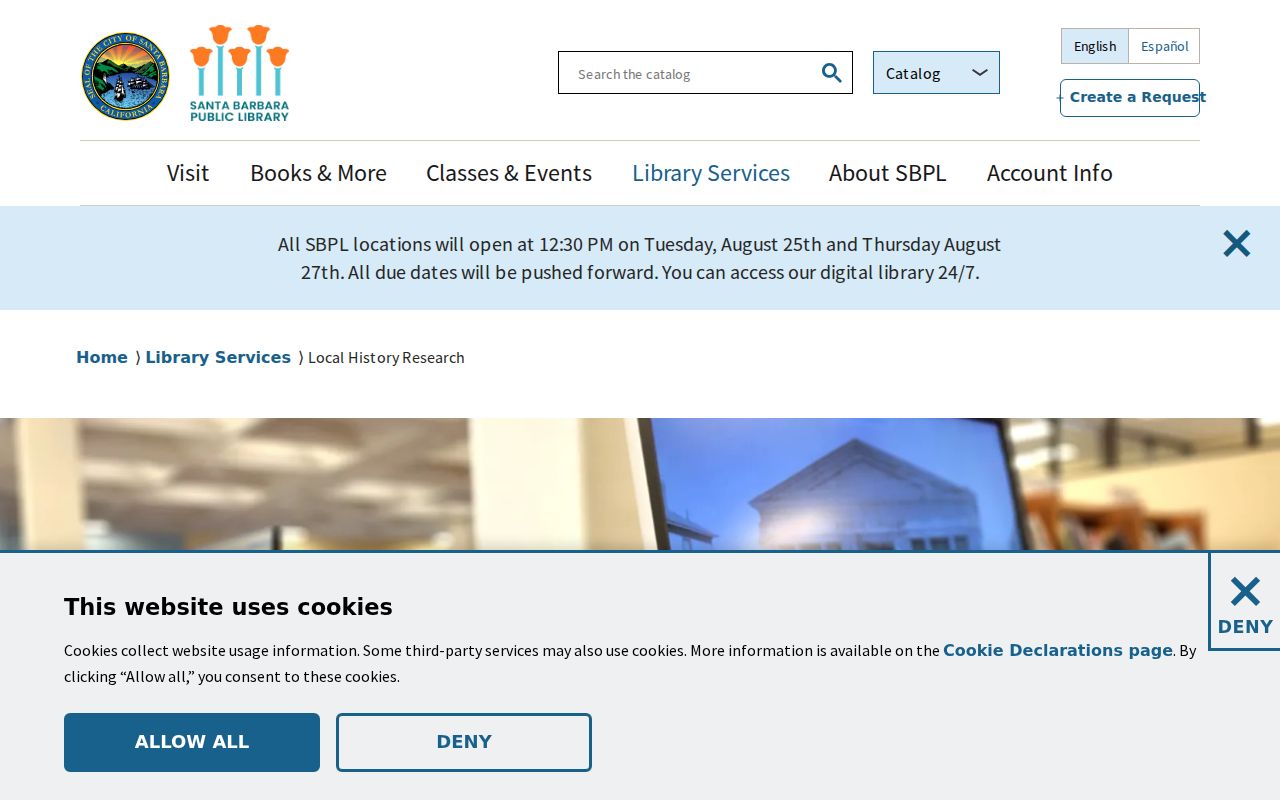
Obituaries supply relationships and dates, but common names still need a second source.