
Goleta Previous Residents across Record Eras
The assessor and parcel map create the APN bridge. The County Clerk-Recorder separates modern and historical real-estate indexes. Permits split around Goleta's incorporation. Directories, census schedules, obituaries, and probate add household or relationship clues, but each has its own coverage and access limit. A search begins with the source matching the question and moves across custody boundaries.
| Source | Years it covers | Where held | What it adds |
|---|---|---|---|
| Assessor parcel bridge | Current address and APN route | County Assessor | Matches a situs to a parcel; no verified public owner-name search |
| Official real-estate index | After 1975 | County Clerk-Recorder | Party, document title, and document-number trail |
| Historical recorder index | 1931-1974 | Historical index | Earlier party and document research |
| Archives, deed books, and maps | 1850-present | County Historical Archives | Older deeds, recorded maps, and county history |
| City and County permits | Post-2002 City; older County evidence | Goleta portal and County Accela | Projects, applicants, contractors, inspections, and case dates |
| Directories, census, and life events | Edition or release specific | FamilySearch, NARA, libraries, SBCGS, and Court | Dated household, obituary, probate, or census clues |
For a recent transfer, start with the parcel and after-1975 index. For a nineteenth- or early twentieth-century question, plan for the 1931-1974 index and the archive route. For past households, pair the land chain with the dated collections. The table is a custody map, not a claim that any one source lists all previous residents.
Note: A deed chain follows recorded land instruments; a directory or census supplies a separate historical household layer.
Follow a Santa Barbara County Deed Chain Backward
Previous residents research should begin with the parcel, not a guessed name. Enter the house number, unit, and street name in the Assessor address form, note each candidate APN and map reference, and confirm the physical situs. The public Assessor form is address and parcel based; an owner-name search was not verified. The recorder then supplies the party and document route. A deed establishes a recorded transaction, not every person who occupied the address.
- Confirm the Goleta situs and APN, keeping the parcel map or legal description beside the address.
- Search the after-1975 index for a recent acquisition using the party, document title, or document number that the County advertises.
- Read the transferring party on that instrument, then search that party as a grantee in an earlier interval.
- Repeat the seller-to-earlier-buyer step while recording document numbers, dates, names, and role labels exactly as shown.
- At 1931, switch to the separate 1931-1974 historical index instead of ending the search.
- For earlier material, ask the Historical Archives about deed books, recorded maps, and archival routes reaching back to 1850.
- Grantor and grantee
- The grantor transfers an interest in the instrument; the grantee receives it. Read the recorded role rather than assuming buyer or seller from a name alone.
- Chain of title
- The linked sequence of recorded transfers for the same land, checked across parties, legal descriptions, maps, and dates.
- Legal description
- The land description used by the instrument. It can identify the parcel when an old street name, number, or postal label has changed.
- APN and situs
- The APN identifies the assessor parcel, while the situs is the physical address. Neither term means a complete list of residents.
Trusts, companies, spouse variations, middle initials, and misspellings can interrupt a chain. A map or legal description is the check against a same-name match. For a whole address history, keep a separate line for ownership evidence and household evidence. The Goleta by-street address workflow is useful when the starting task is a current parcel list rather than a backward house history.
Goleta's 2002 Permit Divide
Goleta's 2002 incorporation changed the likely keeper for planning and building evidence, not the County's deed and assessment role. Newer municipal permit, inspection, mapping, public-works, and business-license cases may sit in the Goleta permit portal. Pre-incorporation files may instead remain with County Planning and Development or County Accela. A permit can date construction or alteration and identify an applicant or contractor, but it is not a household list.
City planning and building
Planning: 805-961-7543, planningcounter@cityofgoleta.gov. Building: 805-961-7552, buildinggroup@cityofgoleta.gov. The counter is open Monday and Wednesday, 8 a.m. to noon; virtual service is also documented.
City code compliance
Code Compliance: 805-961-7556, codecompliance@cityofgoleta.gov. Use a focused case question when the portal does not expose the older file.
County predecessor files
County Accela supports address, parcel, and permit modes. County contact: 105 E. Anapamu St., Santa Barbara, California 93101, 805-681-4200.
A City Clerk request can seek an identifiable existing record, subject to inspection, copies, and exemptions. It cannot compel a new resident list. Record the custodian and search date.
Selected Goleta Directory Points
The strongest directory clue is a verified edition, not a smooth-looking year range. The 1904 Dana Burks' Santa Barbara city directory, published by the Santa Barbara Directory Company, runs 381 pages and names private citizens and businesses in Santa Barbara, Carpinteria, Goleta, Montecito, and Summerland. FamilySearch Digital Library item 2171498 is marked online. It is not proven to be the first directory or a complete Goleta roll.
Verified individual Polk points include 1954, 1967, 1968, 1969, 1974, 1983, and 1984-85. Treat them as selected editions, never a continuous run. Search name variants, occupation or residence clues, and a street or householder section only when that particular edition contains one. A directory line can suggest an arrival, departure, spouse notation, or move; a deed, census, obituary, or permit should test it.
The collection shelves and reading method belong with the Goleta city directories page. For a house history, use only the edition year and field that can be verified, then place the result beside the deed chain.
Note: Selected directory editions are evidence points, not proof of an annual Goleta publication run.
Census Schedules Fill Goleta Gaps
Federal census schedules can add household context between the selected directory years. For Goleta, the useful public sequence runs from 1900 through 1950. Under the current 72-year release rule, 1950 is the latest public census in 2026. The National Archives census route is the authority for access and research guidance. Search the surname and place, then inspect the schedule, enumeration district, address wording, and household relationship fields rather than copying a name into a present-day claim.
- Choose the closest public census year to the directory or deed event.
- Search both Goleta and the older La Patera or La Goleta labels when the place index is broad.
- Compare household members, age bands, occupation wording, and tenure clues with the dated address evidence.
- Record the census year and enumeration district because “Goleta” may describe a wider valley than the modern city.
Census context is not a deed substitute. It can show a household at an enumeration point, while the recorder shows a land transaction. The two sources are strongest when their dates and location language agree.
Obituaries and Probate for Goleta Past Households
Life-event records can explain why a past household disappears from a directory. Santa Barbara Public Library Central offers free in-person local newspaper microfilm. Its mail obituary service charges $25 per person for a ten-day date window, while other local-history work is $50 per 30 minutes with a two-to-four-week estimate. The request needs a name and date or useful names, events, and dates.
The Santa Barbara Public Library local-history route accepts a mail request through its Reference Unit, while the Santa Barbara County Genealogical Society database offers a searchable index of more than 200,000 local names. Its categories include obituaries, mortuary material, burial permits, wills, probate, guardianship, and other unusual county records. Wildcards, date ranges, location choices, and keywords can narrow a result. The index is a lead, so order or inspect the underlying record where available.
Probate cases belong to the Santa Barbara Superior Court case route, not the city directory. Public access varies by category and confidentiality rule. A case number, party role, filing date, and document copy are safer anchors than a bare name. An obituary can suggest a relationship; the probate file or vital record must support the legal fact.
La Patera and La Goleta in Older Records
Older Goleta records may use place names that do not match a modern street search. Research identifies La Patera around Fairview and Hollister and La Goleta around Patterson and Hollister. The La Goleta townsite was laid out in 1875. Search both names, along with Goleta and Santa Barbara County, when a directory, census, newspaper, or deed index omits the current city label.
This is a cataloging issue, not proof of a street rename. No verified year for a Goleta-wide street renumbering was found. No authoritative Sanborn sheet-year list or house-history guide was verified. A gap in a street-name search should lead to APN, legal-description, map, and place-name checks, not an invented date.
A library or archive result may be useful without proving city residence. Keep the historical label and modern jurisdiction separate when comparing past households.
Sahyun Adds a Local History Layer
An insider route for previous residents is the Sahyun Library in Santa Barbara. Research describes more than 22,000 items, over 750 periodical titles, directories, yearbooks, surname and locality files, and maps. The library is a FamilySearch Affiliate, so onsite access may open images restricted from home viewing. Ask the reference desk about the exact edition before assuming a web result is missing.
The Santa Barbara County Genealogical Society holdings list Sahyun at 316 Castillo Street, 805-884-9909, with Tuesday and Thursday hours from 10 a.m. to 4 p.m., most Sundays from 1 p.m. to 4 p.m., and a third Saturday schedule from September through July. Directory and yearbook material can support a past-household clue, while the underlying source still controls what may be copied or disclosed.
Goleta Archives Reach to 1850
The Santa Barbara County Historical Archives are the fallback when the online deed bands stop. County records reach 1850, recorded maps run from 1850 to the present, and the digitized Water Claims Book covers 1877-1918. Those materials can connect land, claims, ranch names, and people in ways a modern address field cannot.
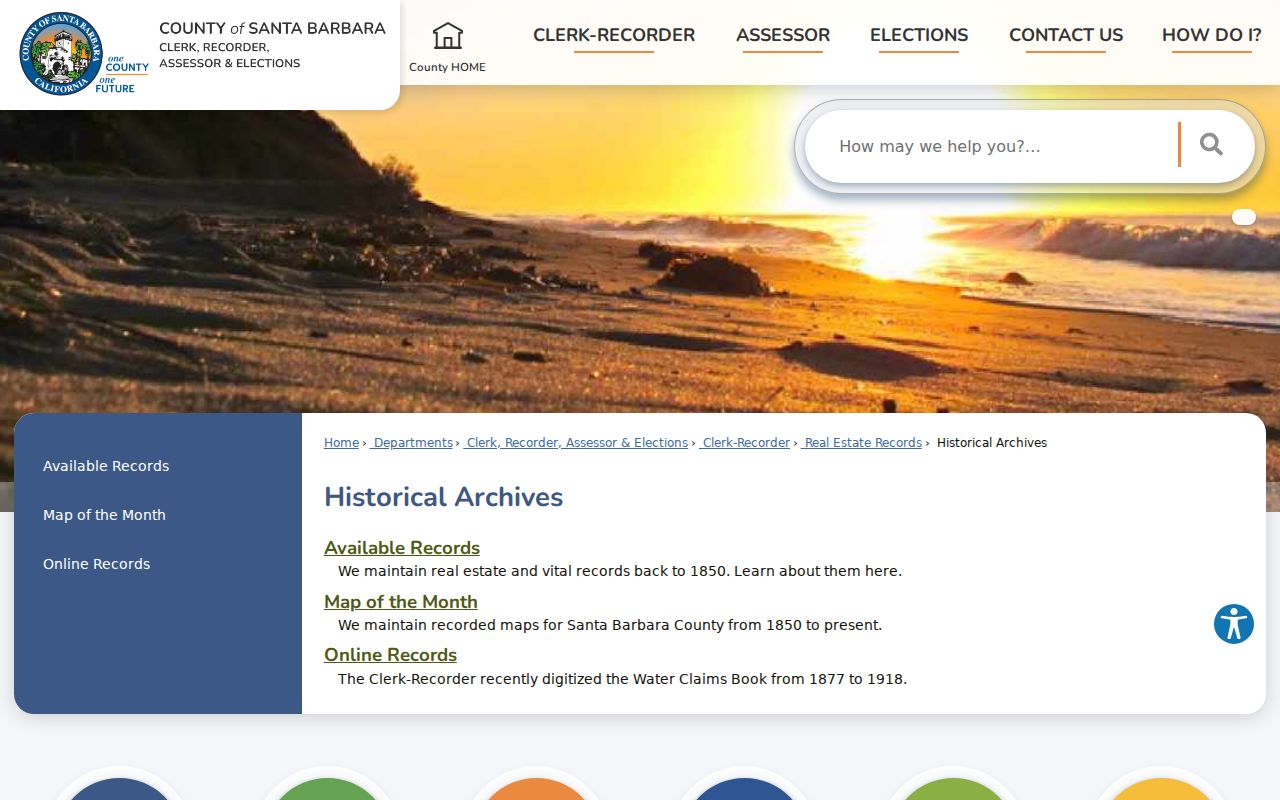
The image points to the County route, not a fabricated sample. UCSB Special Research Collections adds Goleta Chamber, water, airport, railroad, community-development, and personal research collections, with collection-specific dates and box access. The reported 2024 News-Press archive acquisition may become another obituary and address source, but availability and catalog should be confirmed before relying on it.
Note: Archive access and image availability can change, so confirm the keeper's current reading or request process.
Past Goleta Households in Dated Sources
Previous residents research can support family history, a house timeline, estate work, or a careful effort to reconnect with someone. Directories, census schedules, obituaries, and probate files add household or relationship clues, but they do not create a current household list. A deed shows a recorded land interest. A permit shows a project role. A voter file is restricted, and My Voter Status is a self-lookup. Utilities, DMV addresses, and private association member records are not public workarounds.
Protected residents may use California's Safe at Home address-confidentiality program, and confidential voter registration can suppress a residence field. A missing name or blank address is not proof of departure, fraud, or nonresidence. Verify a fact with the custodian that created it and keep living people out of a public-facing conclusion.
Lawful house history. Use Goleta previous residents records for personal, lawful research and family history. Never use a past address to stalk, track, threaten, harass, or harm a living person.